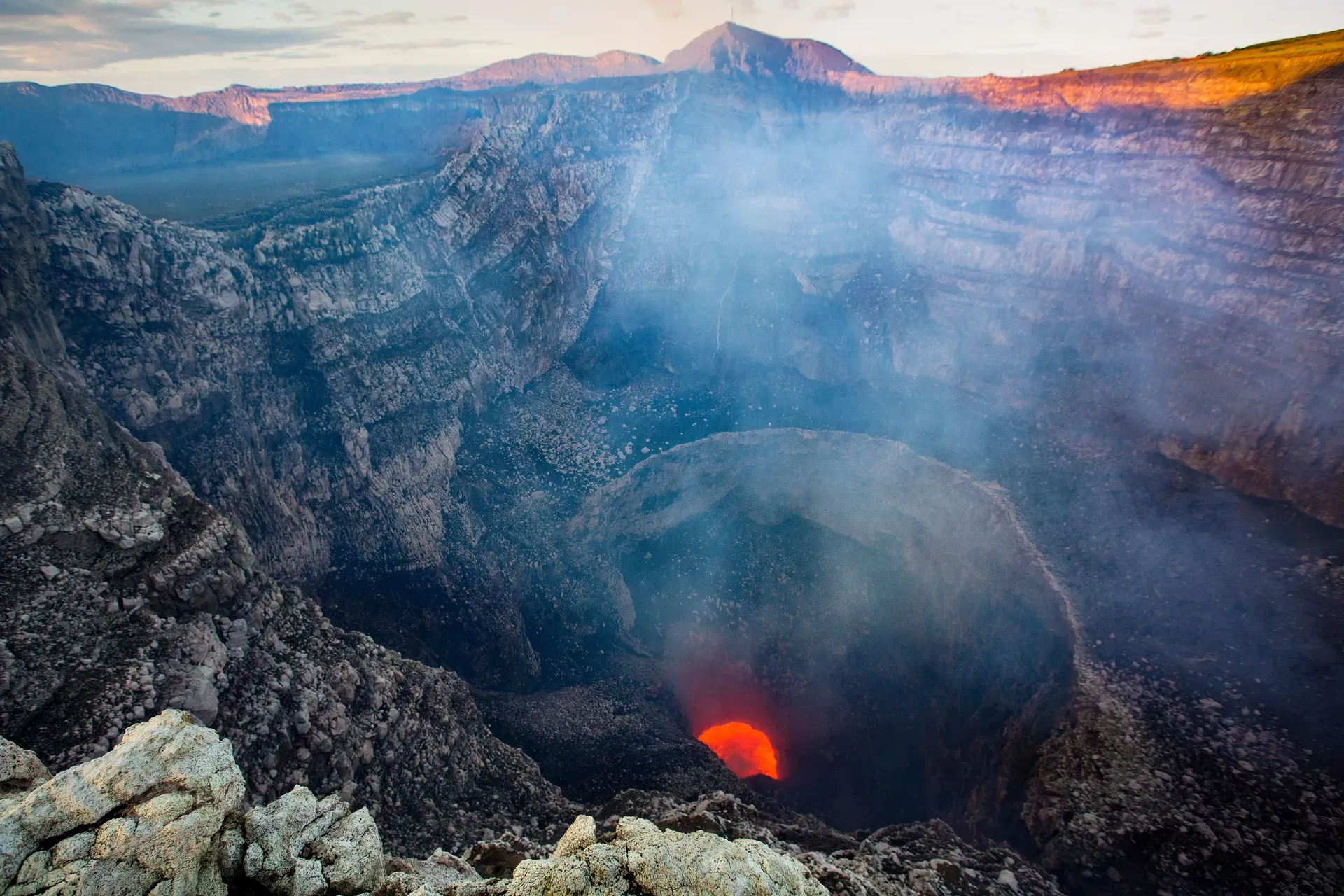
Foreign visitors pay C$150 ($4) for daytime park entry and $10 for the evening lava viewing session. The gates open for regular visits between 8:30 AM and 4:30 PM, then reopen from 5:00 PM to 8:00 PM.
Masaya Volcano National Park operates in two daily shifts: a daytime slot from 8:30 AM to 4:30 PM and a nighttime lava-viewing slot from 5:00 PM to 8:00 PM. Visitors face strict 5-to-15-minute time limits at the crater rim due to toxic sulfur dioxide emissions. Unpredictable volcanic activity or landslides can trigger sudden, months-long park closures.
Swipe to see more
| Day | Hours | Note |
|---|---|---|
| Monday–Sunday | 08:30–16:30 and 17:00–20:00 | Crater rim access is strictly limited to 5–15 minutes per group. |
The park remains open during national holidays, though peak periods in February and March often cause entrance wait times of up to an hour. Heavy rains during the wet season do not force routine closures but will obscure the crater with thick clouds and steam. Sudden geological events dictate actual shutdowns, such as the major landslides in early 2024 that blocked volcanic gas release and closed the site for several months.
Daytime entrance to Masaya Volcano costs C$150 (~$4 USD) for foreign visitors. Nighttime lava viewing sessions run $10 USD for foreigners. Tickets are purchased directly at the park entrance gate, with no advance reservations required for standard access.
Swipe to see more
| Category | Price | Note |
|---|---|---|
| Foreign Visitor (Daytime) | C$150 (~$4 USD) | Valid 8:30 AM to 4:30 PM |
| National Visitor (Daytime) | C$50 | Valid 8:30 AM to 4:30 PM |
| Foreign Visitor (Nighttime) | $10 USD | Valid 5:00 PM to 8:00 PM |
| National Visitor (Nighttime) | $5 USD | Valid 5:00 PM to 8:00 PM |
| Special Night Tour Package | Up to $25 USD | Includes guided access |
| Gate-to-Summit Driver | ~$5 USD | Required for pedestrians arriving by public bus |
No regular free entry days.
Planning your visit to Masaya Volcano? Find tours with free cancellation and skip-the-line options.
View All ToursThe optimal time to visit Masaya Volcano is just before 5:00 PM between September and January. Arriving during this transition window lets you beat the tour bus queues and watch the sunset before the dark sky illuminates the bubbling lava lake. Peak dry season months like February and March bring heavy crowds and hour-long waits at the entrance gate.
Swipe to see more
| Period | Crowd Level | Recommendation |
|---|---|---|
| Morning (08:30–12:00) | Low | Hike the 4-kilometer Coyote or Comalito trails before the midday heat bakes the exposed basaltic rock fields. |
| Midday (12:00–15:00) | Low | Temperatures peak and shade is nonexistent, making this the most uncomfortable time to stand at the crater rim. |
| Late Afternoon (15:00–16:45) | Moderate | Explore the Volcanology Museum and climb to the Mirador San Fernando before daytime operations shut down. |
| Evening Transition (16:45–18:00) | Moderate | Arrive at the gate just before 5:00 PM to secure a prime spot for sunset views over the caldera. |
| Night (18:00–20:00) | High | Darkness maximizes the red glow of the bubbling magma, but wait times at the entrance can reach an hour during peak months. |
A complete visit to Masaya Volcano takes one to two hours. Time at the active Santiago crater rim is strictly limited to 5 to 15 minutes by park rangers due to toxic sulfur dioxide gas. Adding the four-kilometer hike along the Coyote or Comalito trails extends your stay by another two hours.
Get to the entrance gate just before 5:00 PM to secure your spot for the evening lava session. This timing beats the tour buses and lets you watch the sunset before the dark sky makes the bubbling magma glow intensely. Tickets for this slot cost $10 USD for foreigners.
Walking the paved road from the main entrance to the crater is strictly prohibited. If you arrive on a public bus from Granada or Masaya, hire a driver at the gate for approximately $5 USD per person. Private taxis from Granada run about $25 USD and include waiting time at the summit.
Park rangers enforce a strict 5-to-15-minute time limit at the Santiago crater rim. Dense plumes of sulfur dioxide gas continuously rise from the vents, quickly causing throat irritation and coughing. Bring eye drops and step back from the concrete safety wall if the wind shifts the haze toward the viewing platform.
Daytime visits expose you to high temperatures and zero shade across the basaltic rock fields. Wear sturdy, closed-toe hiking boots to navigate the loose volcanic gravel on the four-kilometer Coyote and Comalito trails. Bring high-SPF sunscreen and plenty of bottled water.
Peak dry season brings heavy crowds and wait times of up to an hour at the park entrance. Target April, May, or the September to January window for shorter lines. Heavy rains during the peak wet season generate thick steam that entirely obscures the lava lake.
Daytime entry costs C$150 (~$4 USD) for foreigners and C$50 for nationals between 8:30 AM and 4:30 PM. Evening slots from 5:00 PM to 8:00 PM cost $10 USD for foreigners and $5 USD for locals. Special night tour packages run up to $25 USD per person.
The park operates in two daily shifts. Daytime sessions run from 9:00 AM to 4:45 PM, followed by a nighttime session from 5:00 PM to 8:00 PM. Arrive just before 5:00 PM to beat tour bus queues and secure a spot for the evening lava viewing.
Park rangers strictly limit crater rim visits to 5 to 15 minutes per group. Continuous emissions of toxic sulfur dioxide gas cause throat irritation and breathing difficulties if you linger. Exploring the Volcanology Museum and hiking trails extends a full visit to 1 to 2 hours.
Standard day or night visits require no advance permits. Buy your tickets directly at the park entrance gate upon arrival. Exploring restricted areas like the underground Tzinaconostoc Cave requires booking a certified local guide.
April to May and September to January offer pleasant weather and lower prices. Heavy rains during the peak wet season obscure the crater with thick clouds and steam. February and March bring heavy crowds, resulting in wait times of up to an hour at the park entrance.
Walking along the paved road from the main gate to the crater is strictly prohibited. Visitors must drive their own vehicle, arrive with an organized tour, or hire a local driver. Hiring a driver at the gate costs approximately $5 USD per person for the ride to the summit.
All vehicles parked at the summit must face downhill in the designated parking lanes. This positioning ensures a rapid evacuation if sudden explosive activity or ash emissions occur. Historical eruptions have rained large volcanic bombs directly over this parking area.
Browse verified tours with free cancellation and instant confirmation.
Find Tours